|
ShoreScene: Holiday flora
bloom close to home
Published in the Islander 12/08/00
BY GLORIA STRAVELLI
STAFF WRITER
New York City's Rockefeller Center is
famous for its holiday displays, but the plants and floral arrangements
that wow visitors originate much closer to home.
|
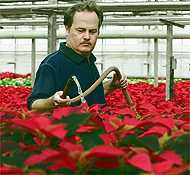
PHOTO: JACKIE POLLACK/STAFF
Bob Hoffbauer, one of
Roehrs' owners, cares for the pointsettias.
|
It's in the greenhouses of Julius Roehrs
Co. Exotic Nurseries that the poinsettias, chrysanthemums and azaleas used
to create seasonal or holiday displays at Rockefeller Center's gardens and
the Easter lilies that adorn St. Patrick's Cathedral at Easter come into
bloom. "We start the poinsettias as early as May," said Bob
Hoffbauer, one of the Roehrs' owners, explaining that growing the 35,000
poinsettias the Howell nursery produces is a formidable challenge.
The poinsettias are grown from cuttings
and take careful nurturing to come into bloom at the right time for holiday
display.
"Poinsettias need 60 days of
complete darkness to set a bract (a petal-like leaf)," explained
Hoffbauer, a Colts Neck resident. "The temperature in the greenhouse
must be kept in the low 60s and feeding is critical."
"If you disturb that rhythm, they
won't cooperate, so we absolutely never turn the light on at night,"
said Karen Hoffbauer.
The Hoffbauers are a brother and sister
team who together to run the 130-year-old nursery. Bob's purview is
production and administration, while Karen oversees sales and marketing.
Bob joined the company in 1975 after graduating from college. Karen left a
career in marketing to help run the nursery.
The two are related through marriage to
the nursery's founder, Julius Roehrs, who immigrated to the United States
in 1864 and became the gardener on a Jersey City estate. (Their father's
uncle married Roehr's daughter).
An accomplished horticulturist in his
native Germany, Roehrs was just 20 years old when he became a gardener on
the estate of a wealthy industrialist, eventually becoming chief orchid
grower. In 1869, he left the estate to found his own nursery on 17 acres in
East Rutherford, where he grew flowering plants for private customers and for
the newly fashionable retail florist shops in New York. He is credited with
helping to introduce tropical plants to the United States.
Today, Julius Roehrs Co. Exotic Nurseries
occupies an 86-acre tract that spans Farmingdale and Howell.
According to Bob Hoffbauer, the nursery
has 200,000 square feet of growing space under glass -- 6 acres -- where
plants from diminutive annuals to the 25-foot ficus trees that grace the 15
buildings and summer garden at Rockefeller Center are grown.
The nursery's 12 greenhouses represent
one of the largest collections of ornamental flora ready for use in the
United States. One of the largest tropical nurseries in the metropolitan
area, Roehrs has an entire greenhouse devoted just to foliage plants.
The major focus of the firm's business is
"greening" corporate offices and shopping malls. The nursery is
one of the largest commercial interior landscape design and maintenance
firms in the metropolitan area, Karen pointed out.
In addition, Roehrs participates in
several major flower shows annually, including Macy's annual flower show,
and supplies many exhibitors at flower shows.
Located on Route 33, the nursery is open
to the public from 9 a.m. to 3 p.m. Wednesday through Saturday.
Bob Hoffbauer pointed out that while
poinsettias are the nursery's major focus at this time of year, they
actually grow more chrysanthemums than anything else.
"We grow mums 46 weeks of the
year," he said, estimating that the nursery produces 50,000 mums for
fall displays. An entire greenhouse is dedicated to growing mums.
"We brought one 600-foot greenhouse
when we moved the company from East Rutherford to Howell, he explained. We
re-erected it, built side houses and added over the years. Our mum house is
fully automated. Computers control the temperature, lighting, shading and
feeding."
"No matter how many we have (mums),
we never have enough," added Karen Hoffbauer. "We grow them from
cuttings and it's 12 weeks from cutting to bloom. We provide 2,000 per week
for interior plantscaping."
While some greenhouses are fully
automated, there is still plenty of hands-on work to be done, both
Hoffbauers acknowledged.
"Absolutely. Potting, watering,
pinching, debudding, making cuttings, rooting are still done by hand,"
Bob said.
"Most things here are done the
old-fashioned way," Karen said.
|